

Mental Health Conference 2026
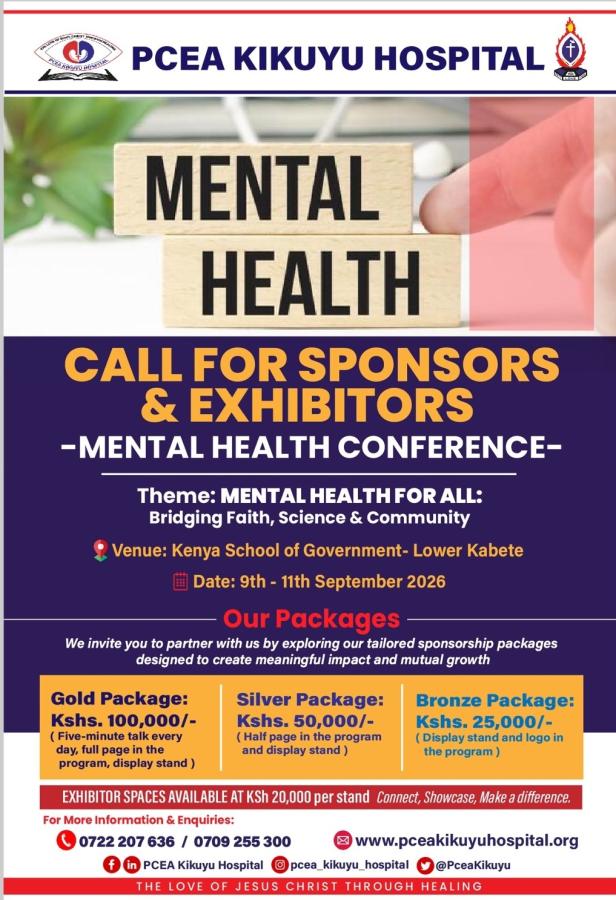
Mental Health Conference 2026
Theme: Mental Health for All: Bridging Faith, Science, and Community
About the Conference
The Mental Health Conference 2026 brings together practitioners, researchers, policymakers, educators, and faith leaders to explore practical and collaborative approaches to mental health.
This years focus centers on bridging faith, science, and community as interconnected systems that shape wellbeing. The conference creates a space for meaningful dialogue, knowledge exchange, and the sharing of evidence-informed and contextually relevant practices.
Participants will engage with emerging ideas, lived experiences, and system-level strategies that strengthen mental health responses across Kenya and beyond.
Shaping the Future of Mental Health in Kenya andBeyond
Mental health is increasingly recognised as a central pillar of individual wellbeing, strong communities, and sustainable development. Across Kenya and the wider region, there is growing awareness of the need for integrated, accessible, and culturally grounded mental health approaches that respond to real-life contexts.
The PCEA Kikuyu Hospital Mental Health Conference 2026 marks the inaugural edition of what is envisioned as a leading platform for dialogue, learning, and collaboration in the mental health space.
Scheduled for Wednesday 9th Friday 11th September 2026 in Nairobi, Kenya, this first conference brings together practitioners, researchers, educators, faith leaders, policymakers, and development partners to engage in meaningful exchange and collective problem-solving.
Anchored on the theme; Mental Health for All: Bridging Faith, Science, and Community, The conference seeks to explore how these three pillars can work together to strengthen mental health systems, reduce stigma, and expand access to care.
This convening will provide space to share experiences, highlight innovative practices, and develop practical strategies that respond to the evolving mental health needs within communities, institutions, and systems.
As a first edition, it sets the foundation for a sustained movement that positions mental health as essential, actionable, and relevant for all.
What We Aim to Achieve
The PCEA Kikuyu Hospital Mental Health Conference 2026 seeks to establish a strong foundation for ongoing dialogue, collaboration, and action in the mental health space. As the first edition, it is both a learning platform and a starting point for building a more responsive and inclusive mental health system.
Guided by the conference sub-themes, the conference will pursue the following objectives:
01 - Strengthen Foundations for Mental Health and Wellbeing
Promote a shared understanding of mental health as a core component of overall wellbeing, with attention to prevention, early intervention, and holistic care across the lifespan.
02 - Advance Digital and Innovative Approaches
Explore practical and scalable digital solutions and innovative models that expand access to mental health services, improve service delivery, and respond to emerging needs.
03 - Promote Mental Health in Education and Youth Development
Highlight the role of schools, families, and communities in supporting the mental health of children and young people, while strengthening systems that integrate wellbeing into education.
04 - Integrate Community, Culture, Inclusion, and Faith
Examine how cultural values, community systems, and faith-based approaches can support mental health, reduce stigma, and enhance acceptance and care within local contexts.
05 - Strengthen Mental Health Response in Crisis and Humanitarian Settings
Identify practical strategies to support individuals and communities affected by crises, including displacement, trauma, and ongoing adversity, with a focus on resilience and recovery.
06 - Strengthen Systems, Policy, and Workforce Development
Support the development of strong mental health systems through policy dialogue, workforce capacity building, and sustainable approaches to service delivery.
07 - Promote Research, Learning, and Knowledge Exchange
Encourage the generation and sharing of evidence, lived experiences, and practical lessons that inform policy, practice, and innovation in mental health.
08 - Build Partnerships and Collaboration
Foster meaningful partnerships across sectors to strengthen coordination, resource mobilization, and collective impact in advancing mental health for all.
This conference is designed to move beyond discussion and contribute to practical, context-relevant solutions that can be applied across communities, institutions, and systems.
Expected Outcomes
The PCEA Kikuyu Hospital Mental Health Conference 2026 is designed to move from dialogue to practical direction. By the end of the conference, the following outcomes are anticipated:
01 - Strengthened Shared Understanding of Mental Health
Participants will leave with a clearer, more grounded understanding of mental health and wellbeing, including prevention, early support, and holistic care approaches that can be applied across different settings.
02 - Practical Adoption of Innovative and Digital Solutions
Stakeholders will identify realistic and scalable digital and innovative approaches that can be adapted within their own institutions and communities to improve access and service delivery.
03 - Integration of Mental Health into Education and Youth Spaces
Concrete ideas and approaches will emerge for embedding mental health into schools, youth programs, and learning environments, with greater attention to early support and long-term development.
04 - Stronger Community and Faith-Based Engagement
Participants will gain practical ways to work with community structures and faith-based institutions to reduce stigma, strengthen support systems, and improve acceptance of mental health services.
05 - Improved Approaches to Mental Health in Crisis Contexts
There will be increased clarity on how to respond to mental health needs in crisis and humanitarian settings, with approaches that support resilience, recovery, and continuity of care.
06 - Enhanced Policy Dialogue and Workforce Strengthening
The conference will contribute to stronger conversations around mental health policy, while highlighting priorities for workforce development, training, and system strengthening.
07 - Increased Knowledge Sharing and Research Uptake
Participants will exchange evidence, experiences, and lessons that can inform future research, practice, and program design within the mental health field.
08 - New and Strengthened Partnerships
The conference will lead to new collaborations and reinforce existing partnerships across sectors, creating opportunities for joint initiatives, resource sharing, and sustained engagement beyond the event.
09 - Clear Direction for Future Engagement
As the first edition, the conference will set a clear foundation for future convenings, with defined areas of focus, priority actions, and a growing community committed to advancing mental health.
These outcomes are intended to ensure that the conference contributes to meaningful progress within communities, institutions, and systems, rather than remaining at the level of discussion.
Conference Sub-Themes
The conference is organised around key sub-themes that reflect the current realities, gaps, and opportunities within the mental health space. Each sub-theme is designed to guide discussions toward practical, context-relevant solutions.
1. Mental Health and Wellbeing Foundations
This sub-theme focuses on strengthening the basic understanding of mental health as part of everyday life. It explores prevention, early identification, and holistic approaches that consider emotional, psychological, social, and spiritual wellbeing. Discussions will also address stigma, help-seeking behaviour, and the role of families and communities in supporting mental health.
2. Digital and Innovative Approaches to Mental Health
With increasing demand and limited resources, innovation is becoming essential in mental health care. This sub-theme examines how digital platforms, teletherapy, mobile applications, and other emerging tools can improve access, efficiency, and quality of care. It also considers ethical issues, data privacy, and the realities of using technology in low-resource settings.
3. Mental Health in Education and Youth Development
Children and young people face growing mental health challenges that directly affect learning and development. This sub-theme looks at how schools, educators, and caregivers can support mental wellbeing through safe learning environments, social-emotional learning, and early intervention. It also explores the transition from childhood to adulthood and the support systems needed along the way.
4. Community, Culture, Inclusion, and Faith
Mental health does not exist in isolation from culture and belief systems. This sub-theme explores how cultural practices, community networks, and faith-based approaches can support healing and resilience. It also addresses inclusion, ensuring that mental health services are accessible and responsive to diverse populations, including vulnerable and marginalized groups.
5. Mental Health in Crisis and HumanitarianSettings
Many individuals and communities experience mental health challenges within the context of crisis, including displacement, trauma, and ongoing adversity. This sub-theme focuses on practical approaches to providing support in such settings, with attention to resilience, recovery, and continuity of care even in unstable environments.
6. Systems, Policy, and Workforce Development
Sustainable mental health care requires strong systems and a well-supported workforce. This sub-theme examines policy frameworks, service delivery models, and strategies for building capacity among mental health professionals and frontline workers. It also considers how to strengthen coordination across sectors to ensure effective and lasting impact.
These sub-themes are intended to guide both reflection and action, ensuring that the conference contributes to meaningful change within communities, institutions, and systems.
Who Should Attend
The PCEA Kikuyu Hospital Mental Health Conference 2026 is designed for individuals and institutions working at different levels of mental health, well-being, and community development. It brings together those directly involved in care, as well as those shaping systems, policy, and everyday environments where mental health is experienced.
Mental Health and Health Professionals
- Counselling psychologists and therapists
- Psychiatrists and clinical psychologists
- Psychiatric nurses and general healthcare providers
- Social workers and case managers
These professionals will benefit from shared practices, emerging approaches, and cross-sector learning.
Educators and Youth Practitioners
· Teachers, school leaders, and school counsellors
· University lecturers and student support services
· Youth workers and mentors
Participants in this group will explore how mental health can be integrated into learning and youth development spaces.
Faith Leaders and Community Practitioners
- Clergy and pastoral caregivers
- Community-based organisation leaders
- Grassroots practitioners and volunteers
They play a key role in shaping beliefs, reducing stigma, and providing frontline support within communities.
Researchers and Academics
- University researchers and students
- Mental health and social science scholars
- Monitoring, evaluation, and learning specialists
This group will engage in knowledge exchange, research dissemination, and evidence-informed discussions.
Policy Makers and Government Representatives
- National and county government officials
- Health and education sector leaders
- Policy advisors and planners
They will engage in discussions on strengthening systems, policies, and service delivery.
Development Partners and Private Sector
- NGOs, INGOs, and humanitarian actors
- Corporate organisations and workplace wellbeing leaders
- Foundations and funding agencies
Their participation supportscollaboration, innovation, and scaling of mental health initiatives.
Students and Early Career Professionals
- Students in psychology, psychiatry, counselling, and related fields
- Early career practitioners seeking exposure and learning opportunities
They will gain insight, mentorship,and practical understanding of the field.
This conference is open to anyone committed to advancing mental health, whether through practice, policy, research, or community engagement.
Call for Abstracts
We invite professionals, researchers, and practitioners to submit abstracts for presentation at the conference.
Abstract Topics
Submissions are encouraged in the following areas:
1. Mental Health and Wellbeing Foundations
2. Digital and Innovative Approaches to Mental Health
3. Mental Health in Education and Youth Development
4. Community, Culture, Inclusion, and Faith
5. Mental Health in Crisis and Humanitarian Settings
6. Systems, Policy, and Workforce Development
Submission Guidelines
- Abstract length: Maximum 250 words
- Submission includes: Title and Abstract
- Email submissions to: irec2024@pceakikuyuhospital.org
Important Dates
- Abstract Submission Deadline: 30th May 2026
- Notification of Acceptance: 17th July 2026
- Full Paper Submission: 14th August 2026
- Conference Dates: 9th - 11th September 2026
Venue: Kenya School of Government, Lower Kabete, Kenya.
Conference Fees
International Participants
- Non-Residents: USD 115
- Non-Resident Students: USD 96
Local Participants
- Residents: KES 10,000
- Resident Students: KES 5,000
Payment Details
M-Pesa Paybill: 4094481
Account Name: MH Conference
Contact Information
Telephone: 0722 207 636 / 0709 255 300
Website: www.pceakikuyuhospital.org
Email: irec2024@pceakikuyuhospital.org
Submit Your Abstract
Be part of shaping the conversation on mental health in Kenya and beyond. Share your work, your insights, and your experience.
Submit your abstract today.
